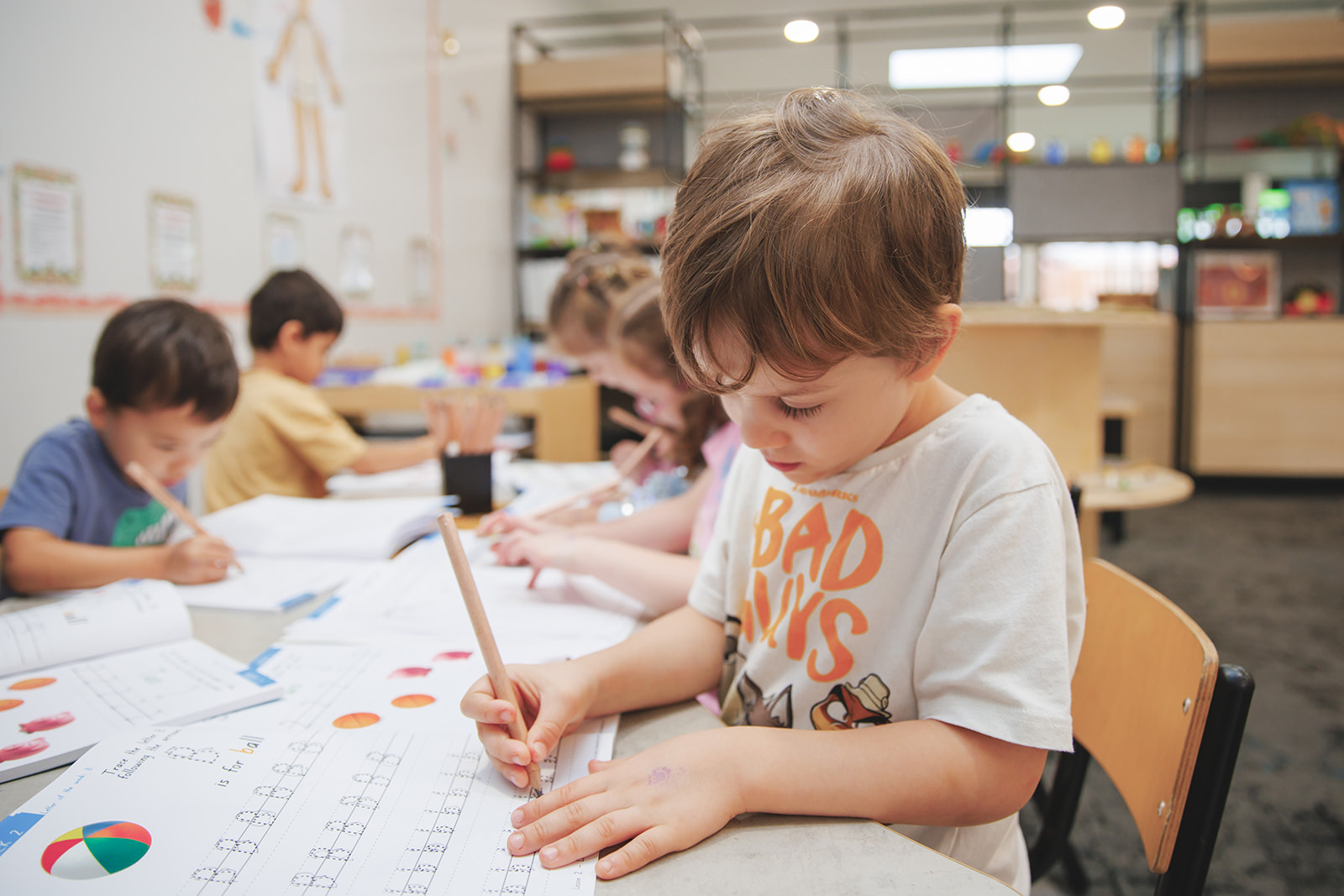
When families and educators talk about children being “school ready,” it’s easy to picture a child who can recognise letters, count to ten, or sit still for long periods of time. But in early childhood education, school readiness is much broader, and far more meaningful, than academic skills alone.
At Mini Masterminds childcare Box Hill and surrounding Sydney suburbs, we understand that being school ready is about supporting the whole child. It’s about building the social, emotional, physical, and cognitive foundations that help children confidently transition into a school environment and thrive once they get there.
School readiness is not a checklist of academic milestones. Instead, it’s a combination of key developmental areas that work together to support a child’s overall wellbeing and ability to engage in learning.
Children who feel secure and confident are more likely to participate, try new things, and adapt to new environments.
Strong communication skills help children connect with educators and peers, making the classroom experience more meaningful.
These skills build confidence and allow children to participate fully in daily activities.
Play-based learning plays a crucial role here, allowing children to explore concepts naturally and at their own pace.
Physical confidence supports participation in both classroom and outdoor activities.
Every child develops at their own pace, and there is no single definition of what school readiness looks like. Some children may be confident communicators but still developing independence, while others may excel physically but need support with emotional regulation.
It’s important to remember that readiness is not about perfection—it’s about progress. Early childhood education services play a vital role in supporting each child’s individual journey, working closely with families to ensure a smooth and positive transition to school.
Early learning environments are uniquely positioned to foster school readiness through play-based, child-centred approaches. Educators focus on:
By embedding learning into everyday experiences, children develop the skills they need without pressure or unrealistic expectations.
Families are a child’s first and most important teachers. When services and families work together, children benefit from consistent support across both home and care environments.
Simple ways families can support school readiness include:
Open communication between educators and families helps ensure that each child’s needs are understood and supported.
It’s important to move away from the idea that children must be “ready” for school in a strict academic sense. Instead, schools and early learning services should be ready for children—meeting them where they are and supporting their unique strengths and needs.
A strong foundation in social, emotional, and developmental skills sets children up not just for school, but for lifelong learning.
What age should a child be school ready?
There is no single age at which a child is or isn’t school ready. While most states and territories require school entry by a child’s sixth birthday, Australian research emphasises that developmental maturity matters more than a fixed milestone. The Australian Early Development Census assesses children across five domains at school entry, because readiness is understood to be multidimensional.
What matters most is steady development across social, emotional, physical, and cognitive areas. Early childhood educators are well placed to track that progress and work with families to ensure children feel confident and prepared before the transition.
Do children need to know how to read and write before starting school?
No. Schools are designed to teach reading and writing, and there is no expectation children arrive already equipped with these skills. What matters more is early literacy awareness: enjoying stories, understanding that text carries meaning, and having a growing vocabulary. These foundations, built through reading together and conversation, are what allow formal literacy skills to flourish.
Pressuring young children to read and write before school can create anxiety rather than confidence. Research shows that a genuine love of language and stories is a stronger long-term predictor of literacy success than early phonics instruction. A curious, communicative child who loves books is well prepared for what’s ahead.
What if my child is shy or struggles socially?
Social shyness is very common in early childhood and should not be treated as a problem requiring correction. Research does suggest it benefits from attentive support: longitudinal studies show children who receive warm, consistent encouragement in early social settings build confidence more reliably than those left to come out of their shell on their own.
A close, trusting relationship between a shy child and their educator is particularly protective. If you have concerns, speaking openly with educators is a good first step. They can share observations and work with you on strategies that build confidence consistently across both home and care settings.
How can I support my child’s transition to school?
Research shows that preparation makes a meaningful difference to how well children settle into school. Building predictable routines at home, practising independence skills, and talking positively about school in the months beforehand all help. Visiting the school and meeting the teacher reduces the unfamiliarity that can make the first day feel overwhelming.
Emotional preparation matters as much as practical preparation. Talk with your child about what to expect, name feelings about new things, and frame school positively. When families and educators share what they know about a child’s strengths and needs, children benefit from continuity of support on both sides of the transition.
What role does play have in school readiness?
Play is the primary vehicle through which young children develop the skills that matter most for school readiness. Through play, children practise problem-solving, build vocabulary, navigate social relationships, and develop emotional regulation. Research from the University of Cambridge found that guided play produces a greater positive effect on key early skills than traditional direct instruction, particularly for mathematical thinking and cognitive flexibility.
Research also shows that children from play-based early learning environments arrive at school as learners, communicators, and empathisers, qualities that position them strongly for what’s ahead. The American Academy of Pediatrics affirms that play supports the nurturing relationships children need to thrive. At Mini Masterminds, play-based learning is the evidence-based foundation of everything we do.
School Readiness
A holistic concept that includes the social, emotional, physical, and cognitive skills children need to transition successfully into school.
Social Development
The ability to interact with others, build relationships, and understand social norms.
Emotional Regulation
A child’s ability to understand and manage their emotions in different situations.
Fine Motor Skills
Small muscle movements, such as holding a pencil, drawing, or using utensils.
Gross Motor Skills
Large muscle movements, such as running, jumping, and climbing.
Play-Based Learning
An educational approach where children learn through play, exploration, and hands-on experiences.
Independence Skills
A child’s ability to manage tasks on their own, such as dressing, eating, and following routines.

 1300 336 464
 Book A Tour
 Enrol Now
 Contact Us
 Call Us